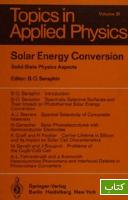
Solar energy conversion
Type doc. :
Langue :
Auteur(s) :
Editeur(s) :
Année d'édition :
Thème :
ISBN :
Afficher le Résumé
The first sections discuss spectrally selective surfaces and composite materials, explaining how their optical properties can be engineered to maximize solar absorption while reducing thermal-radiation losses. The book then examines solar photoelectrolysis, particularly the use of semiconductor electrodes to convert sunlight directly into chemical energy and produce hydrogen. A substantial part of the work focuses on silicon solar cells, especially carrier lifetime, recombination, defects, and their effects on photovoltaic performance. It also examines the Cu₂S/CdS solar cell and the physical problems associated with this technology. The final topics deal with heterojunctions and interfacial defects, emphasizing how semiconductor interfaces influence carrier transport, recombination, and photovoltaic conversion efficiency. Overall, the book provides a valuable physics-based treatment of solar-energy conversion, linking solid-state physics, semiconductor materials, optical properties, interfaces, and photovoltaic technology.
| N° Bulletin | Date / Année de parution | Titre N° Spécial | Sommaire |
|---|
| N° d'Exemplaire / inventaire | Cote | Localisation | Type de Support | Type de Prêt | Statut | Date de Restitution Prévue | Réservation |
|---|