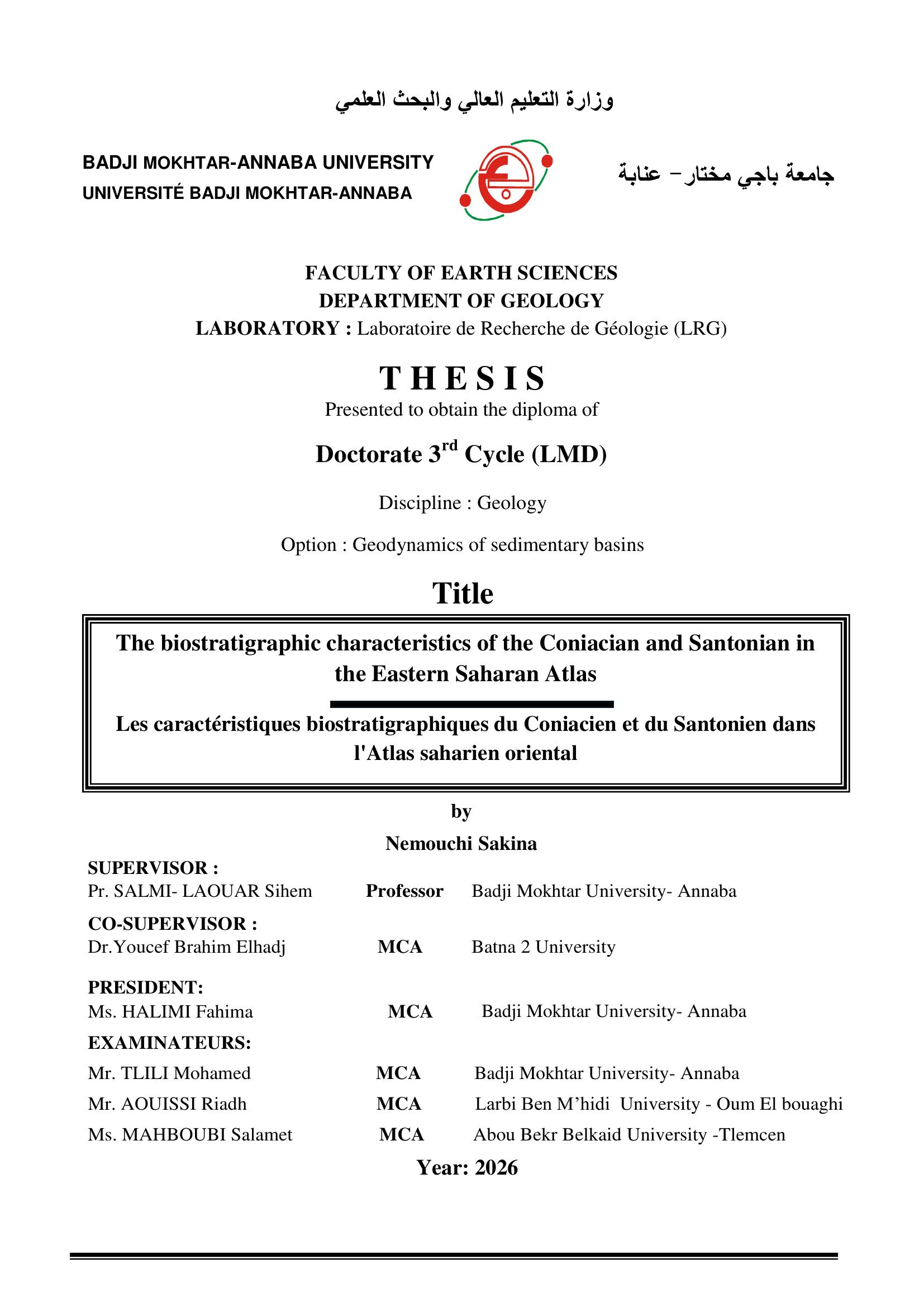
The biostratigraphic characteristics of the coniacian and santonian in the eastern saharan atlas
Type doc. :
Langue :
Auteur(s) :
Année de soutenance:
Thème :
Afficher le Résumé
The study of Coniacian and Santonian deposits in the Eastern Saharan Atlas (northeastern Algeria) spans two areas: the Tébessa Mountains (Essen section) and the Bellezma-Batna Mountains (Boukezez section). Despite their geological interest, these sedimentary series have not been the subject of any detailed study until now. This contribution offers a first integrated biostratigraphic and paleoenvironmental analysis, based on the joint study of macro- and microfossils, including macroinvertebrates, planktonic foraminifera, and ostracods. The dating of the formations is based on the identification of 26 species of planktonic foraminifera divided into 11 genera. Thus, the Coniacian is characterized by the Dicarinella primitiva and Marginotruncana sinuosa Zones, while the Santonian is defined by the Sigalia carpatica, Dicarinella asymetrica and Globotruncanita elevata Zones. Despite the paucispecificity of the Coniacian and Santonian marls in macroinvertebrates, a total of 23 species of bivalves, 4 species of gastropods, 1 species of cephalopod and 5 species of irregular echinoids were identified. The quantitative analysis of this macrofauna allowed to distinguish several characteristic assemblages: (1) Agelasina plenodonta, Cucullaea, Oscillopha– Plicatula and Hemiaster fourneli– Paraesa faba Assemblages for the oniacian; (2) Nuculana cf. mariae Assemblage for the santonian. These marls also contain a microfauna rich in ostracods, with 55 species identified from a total of 10194 individuals. Statistical analyses (NMDS and PERMANOVA) allowed us to distinguish four distinct assemblages: (1) Cytherella aff. austinensis– Cytherella aff. contracta Assemblage and Cytherella ovata– Spinolebris yotvatensis Assemblage, in the Coniacian, (2) Cytherella aff. austinensis– Cytherella aff. elongata Assemblage and Paracypris aff. posteriusacuminatus– Ovocytheridea triangularis Assemblage, in the Santonian. All the quantitative data reveal a marked contrast between the Coniacian and Santonian stages. The Coniacian and early Santonian are characterized by low diversity, a predominance of smooth-shelled ostracods, and anabundance of globose and keeled planktonic foraminifera. The upper Santonian, on the other hand, is characterized by a decrease in diversity and an increased dominance of ornamented species, suggesting an ecological imbalance. An inverse relationship was observed between the abundance of ostracods and that of planktonic foraminifera. Furthermore, the complete absence of ostracods at the Coniacian– Santonian boundary coincides with a dominance of planktonic foraminifera and opportunistic benthic forms. Interpretation of the integrated results from both sections shows that the region underwent a progressive environmental evolution: from a shallow, warm, well-oxygenated, and nutrient-rich marine environment characterized by a hard bottom and stable substrates, but also by isolated environments, restricted faunal exchange, and a significant reduction in benthic habitats during the Coniacian, to a deeper, euhaline, nutrient- nriched environment with more compact and consolidated marly substrates, reflecting a shift toward more favorable climatic and environmental conditions during the Santonian. The observed decline in diversity in the Late Santonian could be attributed to climatic cooling. The transition between the two stages appears to be marked by a punctual environmental disturbance, reflecting moderate dysoxic conditions, without clear evidence of a global anoxic event (OAE3). The Essen and Boukezez sections exhibit comparable sea-level fluctuations and paleoenvironmental evolutions, influenced mainly by local tectonics. Furthermore, the opening of the Trans-Saharan route facilitated faunal connections between the eastern Tethys and the South Atlantic, promoting extensive biotic exchanges along the marine margins. This connectivity explains the similarities observed between the faunas of northeastern Algeria and those of adjacent regions of North and West Africa.
Télécharger Document
| N° Bulletin | Date / Année de parution | Titre N° Spécial | Sommaire |
|---|
| N° d'Exemplaire / inventaire | Cote | Localisation | Type de Support | Type de Prêt | Statut | Date de Restitution Prévue | Réservation |
|---|---|---|---|---|---|---|---|
| 322/2026 | 551 NEM TH C1 | BIB-Centrale / Thèses | Electronique | externe | disponible |