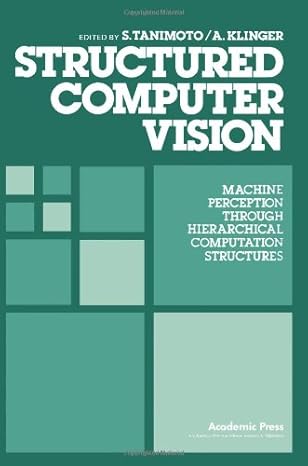
Structured computer vision
Type doc. :
Langue :
Auteur(s) :
Editeur(s) :
Année d'édition :
Thème :
ISBN :
Afficher le Résumé
FROM THE INTRODUCTION: Pictorial pattern recognition is a well-established and active field (1-3) with numerous applications in such areas as document processing (character recognition), industrial automation (assembly, inspec-tion), medicine (cytology, radiology), and remote sensing, among many others. Efficient picture recognition systems are thus a matter of great practical interest. However, relatively little is known about the computational theory of picture recognition. Given a class of digital pictures (i.e., arrays of numbers representing gray levels), and a class of allowable operations on pictures, one would like to be able to answer such questions as: (a) What types of recognition tasks are feasible? For what properties is it possible to determine whether or not a given picture has the given property? (b) What is the minimum number of operations (of the given type) required to perform a given recognition task (for pictures of a given size)? (c) How can the minimum required computation time be reduced by allowing sets of operations to be performed in parallel?
| N° Bulletin | Date / Année de parution | Titre N° Spécial | Sommaire |
|---|
| N° d'Exemplaire / inventaire | Cote | Localisation | Type de Support | Type de Prêt | Statut | Date de Restitution Prévue | Réservation |
|---|---|---|---|---|---|---|---|
| 65933A83 | 004 TAN 10 C4 | BIB-Centrale / Ouvrages | Papier | externe | disponible | ||
| 65935A83 | 004 TAN 10 C5 | BIB-Centrale / Ouvrages | Papier | externe | disponible | ||
| 65936A83 | 004 TAN 10 C6 | BIB-Centrale / Ouvrages | Papier | externe | disponible | ||
| 65939A83 | 004 TAN 10 C1 | BIB-Centrale / Ouvrages | Papier | interne | disponible | ||
| 65940A83 | 004 TAN 10 C2 | BIB-Centrale / Ouvrages | Papier | interne | disponible | ||
| 65932A83 | 004 TAN 10 C3 | BIB-Centrale / Ouvrages | Papier | externe | disponible |