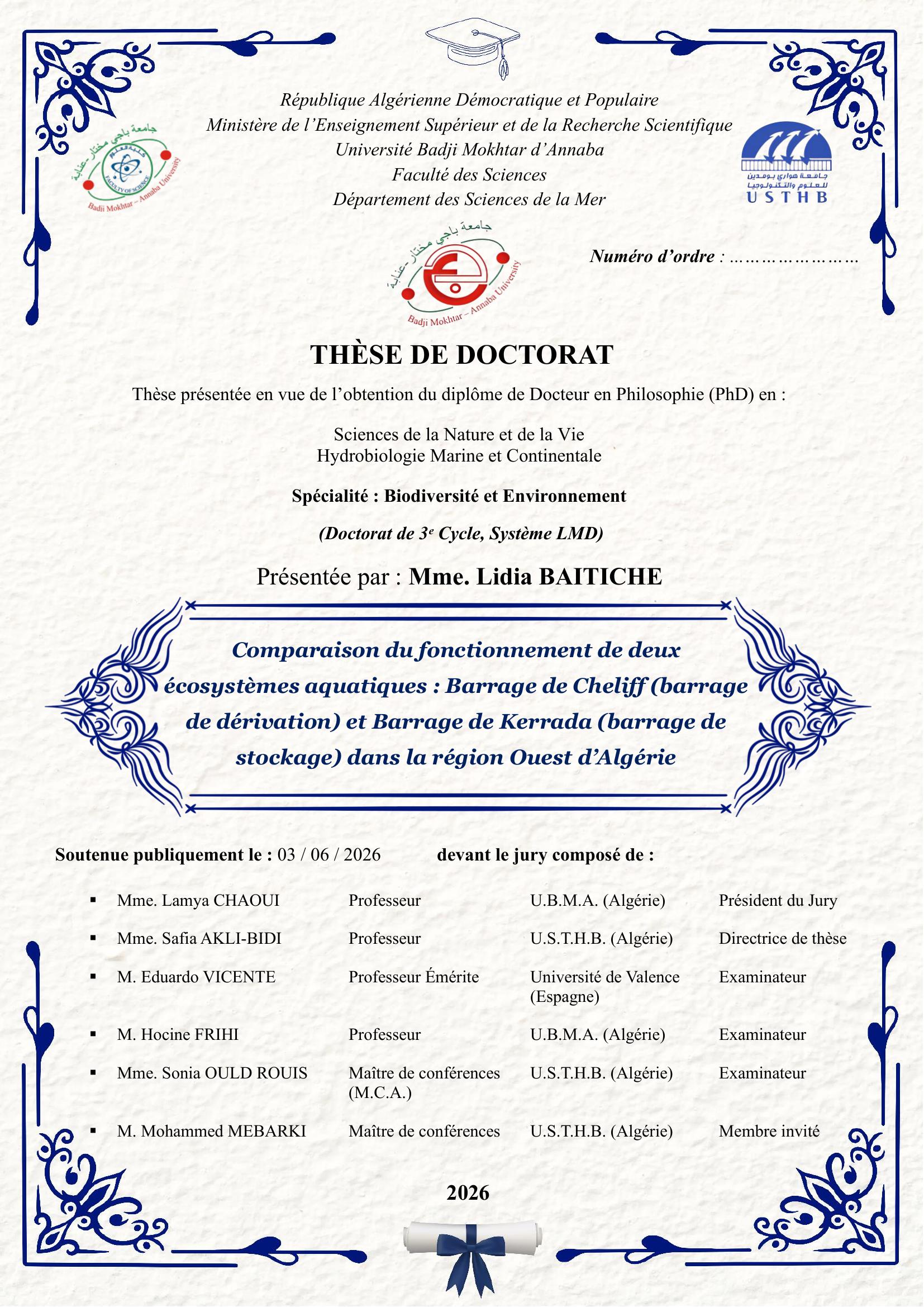
Comparison of the functioning of two aquatic ecosystems: Cheliff reservoir (diversion reservoir) and Kerrada reservoir (storage reservoir) in the western region of Algeria
Type doc. :
Langue :
Auteur(s) :
Année de soutenance:
Thème :
Afficher le Résumé
Plankton communities play a key role in reservoir functioning and water quality assessment. Phytoplankton, as primary producers, and zooplankton, as primary consumers, together form the foundation of aquatic food webs, reflecting trophic status and environmental changes. This thesis provides an integrated ecological assessment of two ydrologically connected reservoirs in northwestern Algeria, Cheliff (a shallow diversion reservoir) and Kerrada (a deep storage reservoir) which jointly supply over 155 hm³ of water annually to Mostaganem–Arzew–Oran (M.A.O.) axis, providing drinking, agricultural, and industrial water to more than two million people. The study aimed to evaluate how morphometry, hydrodynamics, and nutrient regimes influence water quality, plankton community structure, and trophic status under increasing anthropogenic and climatic pressures, while supporting sustainable freshwater management in Algeria. Two years of monthly monitoring were conducted to assess the composition, abundance, and diversity of phytoplankton and the main zooplankton groups (Rotifera, Copepoda, and Cladocera), along with detailed physicochemical parameters. Results revealed strong spatial and temporal contrasts between the two ecosystems. Cheliff reservoir showed higher temperature, turbidity, salinity, and organic matter, reflecting nutrient enrichment from agricultural and domestic sources. In contrast, Kerrada reservoir displayed greater physicochemical stability but remained sensitive to nitrate inflows from its watershed. Phytoplankton assemblages in Cheliff reservoir were dominated by Cyanophyceae, Chlorophyceae, and Euglenophyceae, while Kerrada reservoir supported Cyanophyceae and Dinophyceae. Cheliff reservoir showed frequent blooms of cyanobacteria and euglenoids, while Kerrada reservoir had milder blooms of green algae and dinoflagellates. Zooplankton composition reflected these environmental differences: rotifers dominated in Cheliff reservoir, whereas Kerrada supported more balanced assemblages of cladocerans and copepods. Redundancy analyses identified depth, temperature, oxygen, and nutrient gradients as key drivers of plankton dynamics. Integration of Carlson’s Trophic State Index with plankton-based metrics classified Cheliff reservoir as eutrophic to hypereutrophic and Kerrada as mesotrophic. These results demonstrate that reservoir morphometry and hydrological regimes strongly govern plankton structure and trophic state in semi-arid Mediterranean environments. From a management perspective, eutrophication in Cheliff reservoir may degrade Kerrada’s water quality and increase treatment costs. Maintaining good ecological conditions in Cheliff reservoir is therefore critical for the sustainability of the M.A.O. water system. This study provides the first comprehensive plankton-based ecological assessment of Algerian reservoirs and supports the development of adaptive monitoring tools and management strategies for nutrient control and freshwater sustainability in semi-arid regions.
Télécharger Document
| N° Bulletin | Date / Année de parution | Titre N° Spécial | Sommaire |
|---|
| N° d'Exemplaire / inventaire | Cote | Localisation | Type de Support | Type de Prêt | Statut | Date de Restitution Prévue | Réservation |
|---|---|---|---|---|---|---|---|
| 398/2026 | 574.92 BAI TH C1 | BIB-Centrale / Thèses | Electronique | externe | disponible |