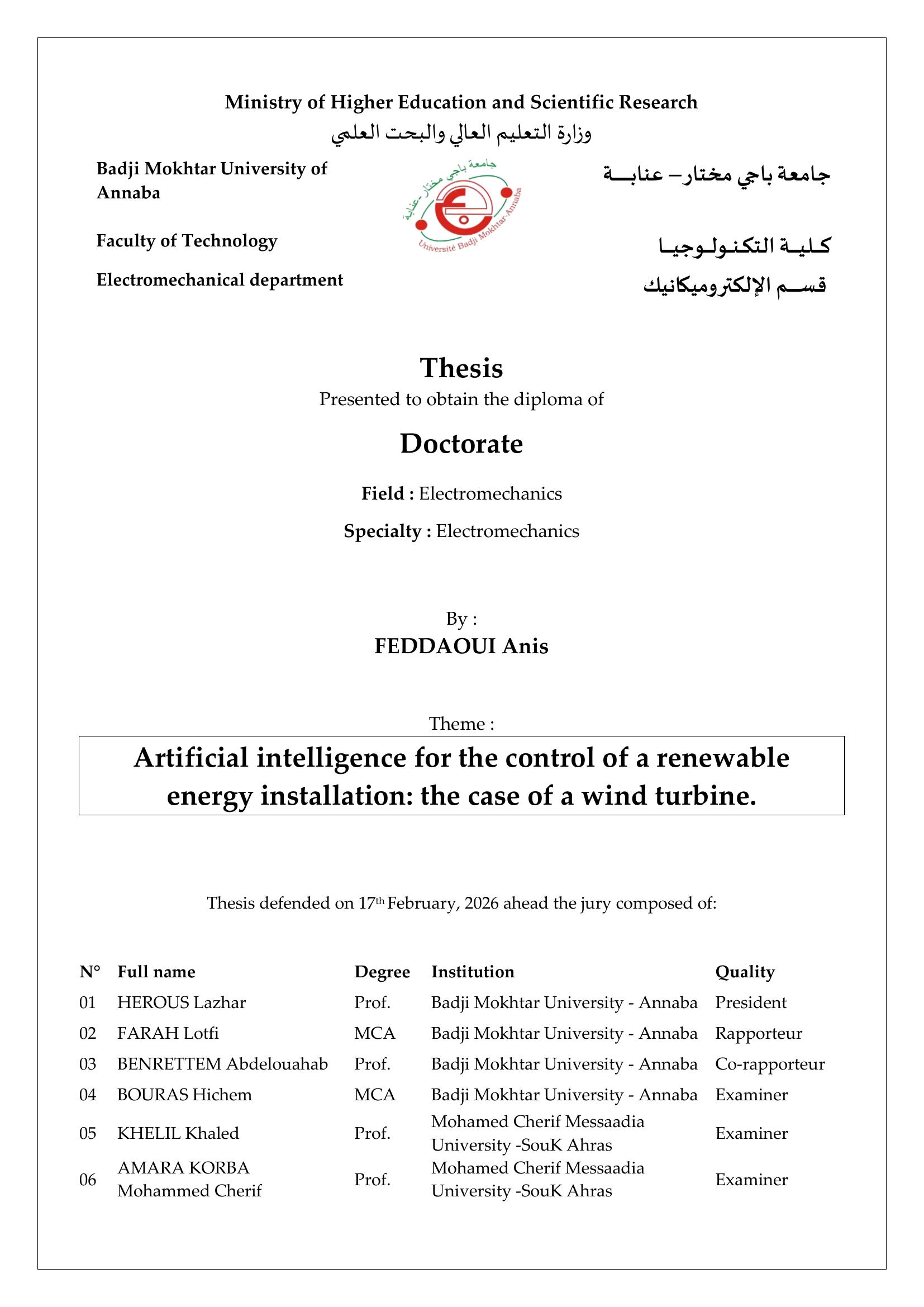
Artificial intelligence for the control of a renewable energy installation: the case of a wind turbine
Type doc. :
Langue :
Auteur(s) :
Année de soutenance:
Thème :
Afficher le Résumé
This thesis investigates advanced control and power management strategies for Doubly Fed Induction Generator (DFIG)-based wind turbines, with a focus on leveraging artificial intelligence (AI) techniques to overcome the limitations of traditional controllers. As renewable energy integration grows, maintaining grid stability and optimizing power output amidst variable wind conditions have become paramount. However, conventional control methods like the Proportional-Integral (PI) controller, while reliable, struggle with the nonlinearities and uncertainties inherent in wind turbine systems, especially under fluctuating wind speeds.To address these challenges, this research introduces AI-enhanced control strategies, including optimized PI controllers, Sliding Mode Control (SMC), Super Twisting SMC, Fuzzy Logic Control, and Artificial Neural Networks (ANN). The thesis begins with a theoretical foundation, providing detailed modeling of the wind turbine’s aerodynamic system and DFIG dynamics, which supports a deeper understanding of control requirements. Following this, optimized PI controllers are examined, with Particle Swarm Optimization (PSO) proving particularly effective for reducing steady-state error, though limitations in rotor power stability indicated the need for more advanced methods.The study advances to explore intelligent control techniques. A hybrid Fuzzy-Super Twisting SMC controller is developed, effectively addressing issues like chattering and demonstrating superior performance in handling nonlinearities compared to classical methods. Additionally, ANN is utilized to enhance the PI controller, eliminating overshoot and achieving smoother responses. These AI-driven controllers collectively demonstrate improved responsiveness, stability, and adaptability in wind turbine control. Expanding to wind farm power management, the thesis proposes a novel algorithm for balancing power across turbines. This algorithm dynamically redistributes power in response to underperforming turbines, effectively maintaining grid stability. Benchmarking against a traditional PI controller, the new approach exhibits precise, proportional power allocation and immediate responsiveness to changing conditions, thereby optimizing overall power output. The findings affirm the potential of AI-based strategies to enhance both turbine-level control and wind farm-level power management. By integrating advanced control algorithms with AI techniques, this research contributes to the development of resilient and efficient wind energy systems, laying the groundwork for future innovations in renewable energy control.
Télécharger Document
| N° Bulletin | Date / Année de parution | Titre N° Spécial | Sommaire |
|---|
| N° d'Exemplaire / inventaire | Cote | Localisation | Type de Support | Type de Prêt | Statut | Date de Restitution Prévue | Réservation |
|---|---|---|---|---|---|---|---|
| 331/2026 | 620 FED TH C1 | BIB-Centrale / Thèses | Electronique | externe | disponible |